
El Colorado: Anatomy of a Volcanic Cone and the Technical Heart of the Central Andes. Ski.
An expert's technical breakdown of El Colorado, Chile. Learn about its 360-degree solar orientation, the Valle Olímpico steeps, and the best gear for Andean snow. Ski.
EL COLORADOEN
Staff Writer – Alta Patagonia Ski Specialist in Mountain & Technical Gear
1/5/20263 min read
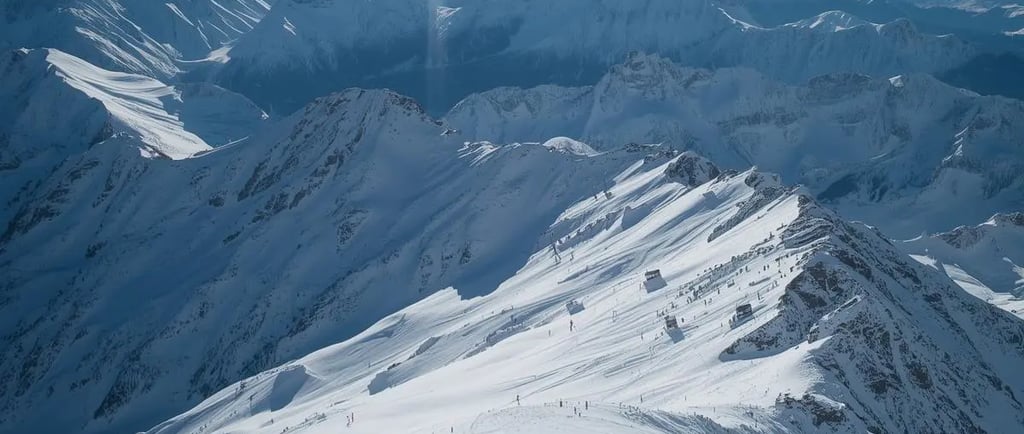
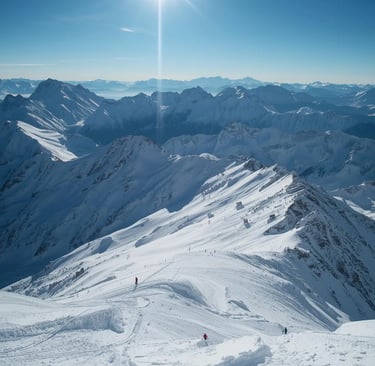
For the skier seeking corporate aesthetics and high-rise hotels, Valle Nevado is the answer. But for the technical skier—the one who understands solar orientation, the one who hunts for the "perfect run" before the sun turns corduroy into slush, and the one who demands real progression—El Colorado is the true gem of the Chilean Andes.
After 15 years covering the Andes for various specialized media, returning to El Colorado is always an exercise in analyzing how the orography of a mountain dictates the strategy of a full ski day. Located between 2,430 and 3,333 meters above sea level, this is not just a resort; it is a near-perfect volcanic cone offering a 360-degree exposure, allowing you to play with shadows and temperatures like nowhere else in South America.
1. Orography: The 360-Degree Advantage
The most relevant technical feature of El Colorado is its shape. Being a conical peak (Cerro Colorado), the slopes unfold radially. For a technical amateur, this is an invaluable strategic advantage.
In most linear resorts, wind or sun affects an entire face of the mountain uniformly. At El Colorado, if the East wind (the dreaded "Puelche") is battering the summit, you simply rotate toward the West or South-facing slopes to find protected, high-quality snow.
Managing "Spring Snow": Toward late August and September, the strategy here is to follow the sun. Start the morning on the East face, waiting for the first light to soften the frozen crust. As midday approaches, rotate toward the North slopes, and finish the afternoon in the Valle Olímpico, where the South orientation keeps the snow cold and compact even under high temperatures.
2. The Valle Olímpico: The Temple of Pitch
If we talk about technical skiing, we cannot ignore the Valle Olímpico. In my view, it is one of the best training grounds for freeride and advanced alpine skiing in Chile. Accessing it via the León chairlift or the El Ancla Poma puts you in a natural amphitheater with pitches ranging between 35° and 45°.
Here, the skier must master edge control on snow that is usually harder due to the lack of direct sun exposure. Runs like "Cornisa" or the natural chutes require high-level shock absorption and perfect centrality. In this zone, a ski with an 85mm to 95mm waist is ideal: wide enough to float after a storm, yet with the torsional stiffness required to eliminate chatter on morning ice.
3. Lift Infrastructure: A Flow Analysis
El Colorado features a network of 22 lifts. Technically, it is a mixed system combining fixed-grip chairlifts with a high number of surface lifts (Pomas and T-bars). To the modern skier, this might seem like a step back compared to high-speed detachables, but there is a technical secret: surface lifts keep the skier on the ground, making them operational even during wind gusts that would force Valle Nevado or La Parva to close for safety.
4. The Sunset Park: Engineering for Freestyle
The Sunset Park at El Colorado is the South American benchmark for design and consistency. The engineering behind its modules is not random. The kicker design aims for a parabola that minimizes impact on the landing, allowing athletes to practice high-complexity maneuvers with a superior margin of safety. Snow density in the park is managed specifically: more compact on the take-off ramps to prevent edge-catching and looser on the landings for safety.
5. Snow Technology and Grooming
An aspect rarely noticed by tourists, but highly valued by technical skiers, is the grooming. El Colorado has invested heavily in a fleet of PistenBully machines that operate all night. Due to high traffic, snow tends to suffer friction that creates ice patches. The "corduroy" ridges left by the machines increase the contact surface of the snow crystal with cold air, helping the run stay "firm" for longer.
6. Technical Recommendations for the Advanced Amateur
If you are heading to El Colorado this season, here is my gear analysis:
Wax: The Central Andes have very dry snow that heats up quickly due to radiation. I recommend a mid-range wax (0°C to -6°C). In September, use a wax with additives for wet snow to avoid the "suction" effect on flat sections.
Protection: At 3,300 meters, UV radiation is 40% higher than at sea level. Use Category 3 or 4 lenses. Corneal damage (keratitis) is the number one technical risk in these high-altitude resorts.
Hydration: Relative humidity can drop below 20%. This affects blood viscosity and muscle response. Drinking 2 liters of water is not a suggestion; it is a technical requirement for precision.
The Verdict: Alta Patagonia
El Colorado does not try to be a postcard-perfect European resort. It is a skier’s mountain. Its technical configuration allows for a progression that spans from the gentle slopes of Farellones to the vertical drops of Valle Olímpico—all within a few kilometers.
It is the place where carved turn technique is tested with every change of face. For this writer, after fifteen winters, El Colorado remains the playground where timing is everything: knowing when to rotate around the mountain is the difference between a mediocre day and a day of Andean glory.