El Colorado Launch: When the Mountain Puts You in Your Place
This is one of those stories that takes your breath away—not just from the impact, but from the dose of humility the mountain serves you just when you think you've got it dialed. It's the classic "overconfidence" moment that ends with an unforgettable "yard sale."
EL COLORADOEN
Mauro | ski enthusiast since 1978
4 min read
There's a dangerous point in every skier's life: that stage where you're no longer a "groomer baby," you leave the basic fear behind, and you start feeling the "flow." You feel like you own the sticks, you think you're "carving on rails," and you launch yourself with a confidence that sometimes borders on "showing off." I was right there.
It was a late-season day at El Colorado. As often happens at that time, the natural snow was in retreat, and the resort was relying on snow guns to keep the runs linked. I was coming down one of those long cruisers that ends at the hotel, "letting 'em run," catching some air off rollers, and just enjoying the speed.
I don't mean to sound like a "hotdogger," but in that moment, I felt like I was "flying." I was carrying respectable speed, maybe 50 or 60 km/h, feeling the wind on my face and that satisfaction of being in total control. Or so I thought.
The Invisible Trap
As I descended, I saw in the distance that the snow changed hue. It wasn't a different color, but it had a different sheen, a texture that today, with years under my belt, I'd spot a "mile away," but back then I "ignored with Olympic-level denial." My mistake was failing to "read the run." Instead of taking precautions, I just kept my line. I scrubbed off a little speed, maybe down to 30 km/h out of pure instinct, but I went in straight.
What came next was a matter of milliseconds.
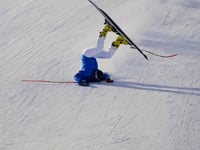
The instant my skis hit that transition—which was a sticky, grabby mix of man-made snow cooked by the afternoon sun—the effect was like driving my "boards" into wet concrete. The skis planted and stopped dead, as if someone had thrown on a "pizza wedge" instantaneously. But my body, carried by pure momentum, didn't get the memo.
I went airborne. Literally.
I felt myself do a perfect cartwheel in the air. The world spun: sky, snow, sky, snow, until I landed with a dull thud and an internal crunch that reverberated up my entire spine. I felt the infamous crack. I just lay there, feeling that heavy silence that follows a massive wipeout, while the pain slowly started to announce itself throughout my body.
The Insurance Dilemma and the Survival Instinct
While I was lying there, sprawled on the snow at El Colorado, my head wasn't just processing the physical pain, but also a rather particular logistical problem. At that time, I was living in Argentina and in the middle of moving back to Chile. I had my health insurance over there, on the other side of the range, and my coverage in Chile was, to put it mildly, non-existent at that moment.
I stayed still, taking inventory. "If this is serious," I thought, "I'm in deep powder." The plan in my head was almost movie-worthy: if the pain didn't ease up in a couple of days, I'd catch a flight to Argentina, get treated there, and call it good. It was crazy, but on the mountain you think strange things with adrenaline and shock all mixed up.
Luckily, the body is resilient. By the second or third day, the pain began to subside. I did some exercises, my own version of PT, a lot of patience, and miraculously, the worst of it passed. And here comes what defines us as skiers: the minute the pain let me move, the first thing I did was grab my skis and head back up the hill.
Farewell to the Central Andes
That was, without knowing it at the time, one of my last times skiing the Central Andes. It was a kind of crash-and-burn farewell on the very same run where, years earlier as a kid, I'd had my first "big" accident.
On that childhood occasion, I had a head-on collision with a "Jerry" who didn't know the mountain code. I was just a kid, but I already knew the unwritten rules of the snow: the downhill skier has the right of way, and you, coming from behind, have to anticipate. This guy turned right into my line, and we both ended up in a heap. But that was a learning crash; El Colorado one, as an adult, was a reality check.
The mountain has its own way of teaching you. It gives you confidence, lets you play, but every now and then it "sends you for a ride" to remind you who's really in charge. That cartwheel knocked a bit of the cockiness out of me and gave me a whole lot more respect for changes in snow conditions.
Those were my last tracks in the central zone before I left. I took with me the memory of the El Colorado air, the bitter taste of man-made snow grabbing me to a halt, and the satisfaction of knowing that, despite the crunches and lapsed medical coverage, I always got back on my feet.
Like I always say, snow gets in your blood. And even though my runs are now far from the Andes, every time I see a change in the snow's surface, I remember that flight and smile. Because if you haven't "eaten it" like that, you can't say you've truly lived the mountain life.
I'll tell you more stories later—I left plenty of them scattered all over the ground in the Andes! ❄️🤕