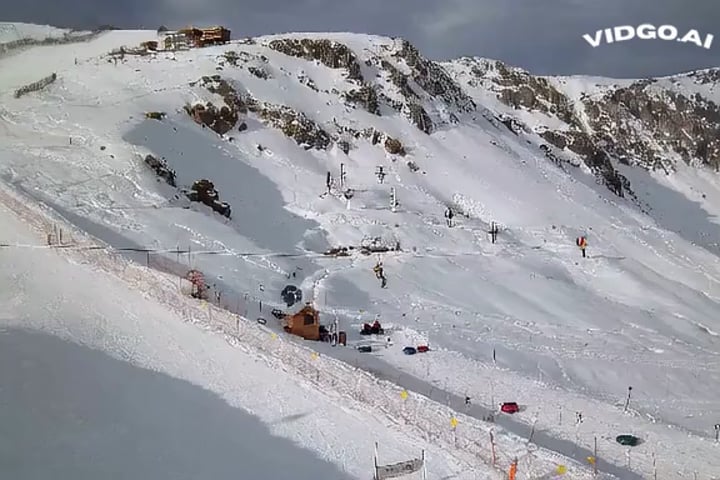
Mountain Rescue at Farellones: A True Story of Grit & Ski Patrol. Farellones ski
Discover a gripping first-hand account of a mountain rescue in Farellones, Chile. From a broken foot to piloting a rescue toboggan, learn what it takes to handle an emergency on the Andes slopes. Farellones ski
FARELLONESEN
Mauro
3 min read
Time skip. I’m no longer the eleven-year-old kid discovering snow for the first time. Now, I’m seventeen, in my senior year of high school, and skiing has become more than a hobby—it’s my domain. I’d spent years on the mountain, often cutting class on Tuesdays because the lift passes were cheaper, racking up flight hours in my legs and goggle tans on my face that I wore like medals of war.
A Rookie on the Loose
That winter, an opportunity came up through the Central Bank, where a friend’s father worked. They organized a trip to Farellones, and we joined in. My friend was a total "never-ever," a complete novice, so I spent the morning teaching him the basics: the snowplow (the wedge), balance, and how not to take anyone out on the bunny slopes. The snow was forgiving, and he picked it up quickly—enough for me to let him off the leash for a bit.
By the afternoon, the mountain was calling. I needed to leave the green circles behind and find something with more pitch, something "darker." I headed out to do my own thing, to feel some real speed.
I was mid-run when I saw something that didn't fit. A figure down in the snow, on a trail that was definitely not meant for someone who had just learned how to step into their bindings that morning. I did a hockey stop, spraying a wall of snow, and his face said it all before he even spoke.
—"I broke my foot!" —he shouted, caught between pain and panic.
The Call to Action
I told him not to move. I stabilized the area as best I could and took off to find Ski Patrol. I got lucky and found a patroller quickly, but he was alone, hauling one of those sled-style toboggans you never want to see up close.
After he checked my friend, the diagnosis was instant: "He can’t ski down. We have to load him into the sled." But then the patroller looked me dead in the eye and dropped a bombshell:
—"I’m solo. I can’t navigate this toboggan with him in it down this pitch unless you help me."
I froze. I had never tailed a rescue sled in my life. It was a massive responsibility.
—"What do I need to do? It’s my first time," —I said, adrenaline starting to surge.
—"Don't worry. I’ve got the handles and the steering. You just follow my lead and maintain control from the tail. Let’s go."
The Descent: A High-Stakes Slalom
We strapped my friend in like a mummy and began the descent. It was no walk in the park. Maneuvering a rescue toboggan is like skiing a giant slalom, but with a dead weight pulling at you through every transition. At first, I was stiff, but the patroller was a pro.
—"Close the tail! Set your edges now!" —he’d yell over his shoulder as the sled started picking up dangerous inertia.
On the steepest pitches, gravity threatened to let the sled overtake us, and I could feel the burn searing through my quads. The patroller used technical jargon I understood perfectly from my years on the slopes: he’d ask me to "anchor" my skis while he looked for the fall line to control the angle. When we picked up too much speed, he’d throw a hard side-slip to scrub the momentum and bark: —"Hard wedge in the back! Don't let it fish-tail!"
I had to kick my tails out to the max, digging my edges into the hardpack to act as a counterweight and keep the sled from rotating. It was a constant battle against weight and incline. Eventually, we fell into a perfect synchronization, carving wide, powerful turns across a massive face. Every instruction he shouted back was like a flight command; I would adjust my stance, drive my weight into the downhill ski, and keep the sled aligned.
Gradually, we established a constant, rhythmic speed. I don't remember the name of the run; I only remember the feeling of absolute power and control in a high-stakes situation.
The Hero Treatment
We reached the base. The medics took over, put him in a cast, and the Sunday glory came to an end. The next day, Monday, I didn't go to school. I was wrecked—the stress and physical exertion had taken their toll. But my friend went, sporting his brand-new cast and a sunburnt face with a bright white goggle tan, the unmistakable mark of a weekend in the mountains.
I returned on Tuesday, also wearing my "sun-mask." The moment I walked in, I felt the stares. My classmates swarmed me, not to ask how I was, but with an admiration I hadn't expected.
—"Hey, is it true you brought him down in the sled?" —they asked. —"Tell us how it went!"
My friend had told the story, but he’d given me the lead role. I told them the truth: that the Patroller was the one in charge and he taught me on the fly; that it wasn't rocket science if you had the legs for it. I got the "hero treatment" for days, and my friend, curiously enough, got a little jealous. He was no longer the star of the story—the focus had shifted entirely to the rescue.