
Patagonia First-Hand: A Day in the Life at Cerro Catedral. Skiing Argentina
Join us for a full day in Bariloche. From the technical chutes of Sector Cóndor and touring to Refugio Frey, to the best local food at Manush and Rapa Nui. Experience Patagonia first-hand. Skiing Argentina.
CATEDRALBARILOCHEEN
altapatagonia.ski Staff
1/5/20264 min read
I’m not sure exactly when the day started, because on the mountain, time loses its meaning. But I know it didn’t start with epic excitement. It started with cold hands, accumulated sleep, and that strange sensation of waking up while already in motion.
I rode up without music, speaking to no one, listening only to the hum of the lift and the wind. As I gained vertical, I understood once again why Cerro Catedral cannot be read quickly. From below, it looks orderly, almost domesticated. But up top, it changes. It becomes serious, massive, and unforgiving of distractions. The first few meters are about adaptation: observing the trees, the color of the snow, the pitch, and the movement of other skiers. There is no time for fantasies; the mountain demands presence.
The Inversion: Clouds Below, Condors Above
When I finally reached the summit, the first thing I saw was Lake Nahuel Huapi. Not as a postcard or a wallpaper, but as a real, immense mass extending until the eye could no longer distinguish water from sky. Below me were the clouds—clearly below, not around me, but under my feet, moving slowly as if I were standing somewhere I didn’t belong.
I stood there for several minutes doing absolutely nothing. Literally. I didn’t adjust my boots, I didn’t check my watch. I just breathed, grasping the scale of it all. While I stood still, condors began to pass by, flying just meters away without effort or drama, using the wind as a basic tool. I didn't feel anything mystical. I felt location. I understood that I was there on borrowed time and they were not. That realization grounds you fast.
Sector Cóndor: No Room for Improvisation
After that pause, I finally moved. I buckled my boots, read the terrain, and almost without thinking, headed toward Sector Cóndor—because some places call to you without explanation. The Cóndor isn't friendly. It’s not for everyone, and it doesn’t apologize for it.
The snow that day was heavy but stable—not "postcard powder," but real Patagonian snow that demands you stay awake. I crossed paths with locals who were descending quietly, and we understood each other without introductions. We entered narrow couloirs where there is no margin for improvisation; those spots where you stand at the top, visualize your line, breathe, and decide. After that, you stop thinking because there is no space to think, only to ski well. Every turn is a decision; every jump over a natural feature reminds you why you are there. At one of the stops, breathing hard, another condor crossed the valley. No one said a word. No one needed to.
Refugio Frey: The Granite Cathedral
At noon, fatigue set in for real, so I skied down to eat without romance. I found a small hut, away from the noise, smelling of firewood and hot food. I ordered something hearty and drank wine, staying longer than planned, watching through the window how the light shifted on the mountain. Staying still is part of the day, too.
Later in the afternoon, I grabbed my touring gear and headed toward Refugio Frey. This place always triggers the same feeling in me: respect and calm. It’s not "extreme," but it carries a heavy aesthetic. The granite towers box you in, and the lagoon appears suddenly. The path is a parade between massive rocks and virgin snow, and every step reminds you there are no shortcuts: you have to advance with care, measuring your strength. The snow there was protected from the wind, allowing for long, unhurried turns. The sensation of being in a place almost untouched, cold air filling your lungs, is hard to explain, but it marks you.
The Transition: Base, Beats, and Beer
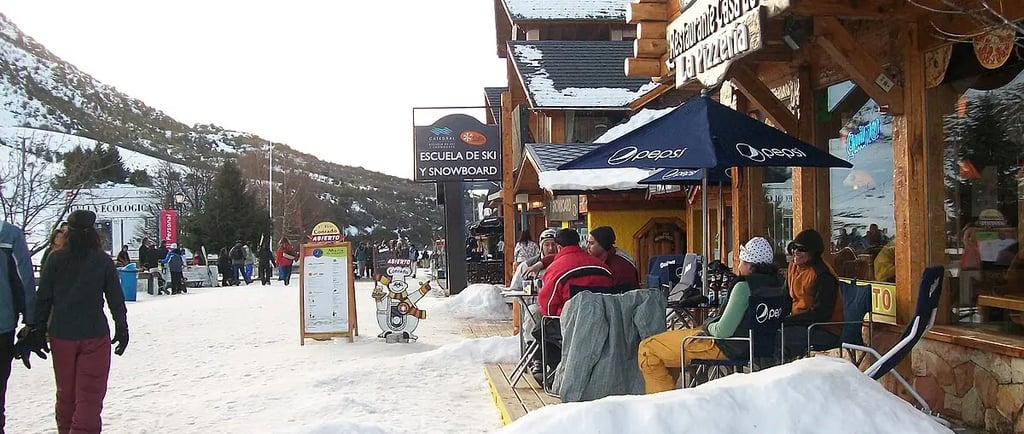
When I returned, legs burning and body begging for a truce, the mountain was emptying out. At the base, the climate shifted: music, people unbuckling boots, laughter, shared exhaustion. I stopped at Mute, unbuckling my boots as the sun hid behind the peaks and a DJ set the rhythm for the transition from day to night. Between craft beers and quick conversations with strangers who felt like old friends, I understood that après-ski here isn't a pose: it’s catharsis.
Later, I followed the road along the lake to Cervecería Patagonia at kilometer 24.7. I sat on the terrace with a pint of "24.7" (an Elderberry IPA), watching the sun stain the lake in purples and oranges that no camera could do justice. That moment was absolute peace after the adrenaline of the Cóndor chutes. Life seemed to slow down. The beer was cold and bitter, perfect.
The Flavors of Bariloche
By nightfall, downtown Bariloche welcomed me with low lights and the scent of hot chocolate on every corner. I walked down Calle Mitre aimlessly. I walked into Rapa Nui almost by inertia and didn't leave without tasting Franui—those frozen raspberries dipped in two types of chocolate that have become a cult classic among skiers.
For a real dinner, I ended up at Manush, a tavern with soul. I ordered the Patagonian lamb stew; it melted in my mouth, concentrating everything this rugged and generous land represents. Eating there after a day like this is like closing a circle, replenishing body and spirit at once.
The Verdict
If I had to summarize the day, I’d say Catedral is pure contrast: technique up high, refuge down low; silence at the summit, noise at the end of the day. It’s not a place to check off a list; it’s a place to stand still, watch the clouds beneath your feet, see the condors, and understand that not everything needs an explanation.
I came back with my skis marked by rocks—scars of decisions made while tired—but with a clearer head. Patagonia doesn't give you direct answers; it removes the noise, arranges your questions, and forces you to face yourself and the terrain in front of you. And that, in the end, is enough. Because at Cerro Catedral, you don't conquer anything: you let yourself be conquered.