Portillo: Speed Skiing History and the Day I Truly Fell in Love with Skiing
Discover Portillo's legendary ski history: the 1978 200 km/h speed record and a lifelong skier's personal tales of crashes, breakthroughs, and passion in the Chilean Andes. Read Mauro's story now.
PORTILLOEN
Mauro | Lover Ski since 1978
4 min read
Back then—no idea if it still works like this—the hotel staff were allowed to bring their kids or relatives (I fit the bill) for a few days, paying a minimal, almost symbolic fee. Everything went on the famous “CP” (Personal Account). I remember perfectly that feeling of importance: you’d walk into lunch surrounded by Americans and pro skiers, swipe the card like you knew exactly what you were doing, say “CP,” and they’d punch it. For a kid, having that kind of “power” in a luxury ski hotel was pure magic.
The Click: Between Crashes and Giant Turns
My first days were, honestly, a disaster. Skiing didn’t like me, and I didn’t like skiing. I ate it—hard—an obscene number of times. I’d submarine into powder, cross my skis, end up twisted like a ball of yarn. But after enough hits, something clicked. Suddenly the logic of weight transfer made sense, balance found its place, and I understood the relationship between my shoulders and the fall line. From that moment on, everything changed. I truly started to love skiing—and once that happens, there’s no going back. It’s a lifelong romance.
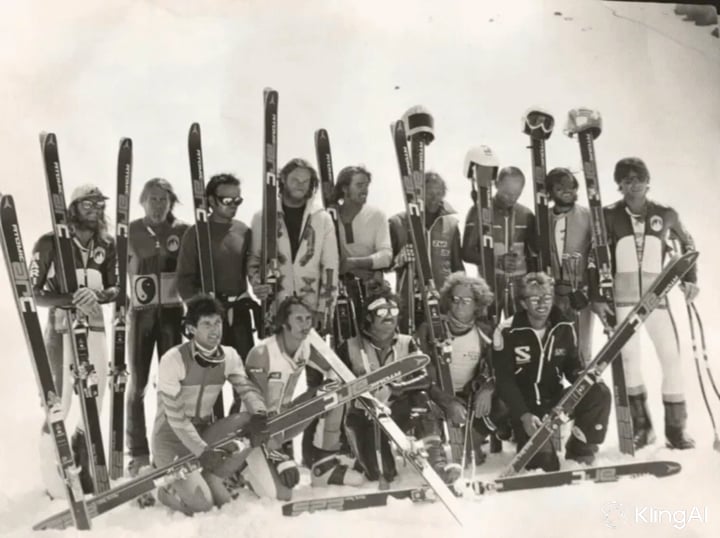
That year, Portillo was a carnival of snow and adrenaline. Journalists from all over the world, elite teams in uniforms that looked like space suits, cameras everywhere. I had never seen professional skiing before, and suddenly I was surrounded by skis over two meters long, heavy as beams, and bizarre prototypes with aerodynamic shapes.
That’s where I saw Steve McKinney, the American pioneer. The man was a force of nature. It was right there in 1978, on our snow, when he broke the 200 km/h barrier. Seeing that kind of speed up close—hearing the air scream as those red-suited men flew past—completely blows your mind. I watched with eyes wide open, feeling like I was standing at the center of the universe.
Learning from the Best (Chasing the U.S. Team)
Over time I realized something that bruised my ego a bit: I could ski, but I had no style. I got down the hill, sure; I arrived in one piece, also true. But it was all brute force and zero elegance. I looked like a tractor charging down a dune.
Years later, on one of my returns to Portillo, I crossed paths with the U.S. women’s ski team during their preseason camp. They skied out together, in formation, and I—feeling very casual about it—latched onto the back of the group. I tried to imitate them on long slalom turns, copying every movement, aiming to put my skis exactly in their tracks.
Spoiler: I couldn’t keep up for long. After four or five minutes they’d drop me completely; their speed and physical conditioning were on another level. But the visual learning was brutal. Those women skied like ballet dancers on snow: flawless technique, knees like springs, total fluidity. I watched, copied, and corrected myself on the fly. Every two or three runs I’d manage to catch them again on the Escuela 1 and 2 lifts, just to keep studying their craft.
That said, I was terrified of bumps. I still hadn’t mastered the art of absorption—letting the legs do the work, setting edges precisely, hopping from mogul to mogul as if gravity didn’t apply. They made it look like a dance. I tried, and at best survived without ejecting my skis. They probably thought I was some deranged kid stalking them around the mountain, but at that age you don’t care what anyone thinks. I just wanted to stop skiing like a piece of lumber.
Lagunillas and the Leap into the Void
As much as Portillo was my spiritual home, I explored other places too. Lagunillas, for instance, was my real school of courage. It wasn’t the most sophisticated resort, but it was honest—and affordable—the perfect place to learn. That’s where I decided it was time to stop being a “flat-slope skier” and face true vertical.
I remember one lesson in particular. The instructor took me to a zone of steep pitches—near-vertical walls of snow that, from the top, felt like stepping into empty space. The wind was howling, the cold cutting straight to the bone. He looked at me, said very little, dropped in first with insulting ease, stopped far below as a tiny orange dot, and yelled up: “Do exactly what I did!”
I stood there alone. The mountain’s silence was deafening. I took a deep breath, felt the icy air burn my throat, and went for it. The first seconds were pure instinct. I felt like I was flying. Speed built instantly, my heart was hammering, and then—suddenly—I started linking turns just like I’d been taught. Adrenaline ran like liquid fire. I reached the bottom shaking, not from cold, but from emotion. That afternoon we repeated that run over and over until my legs begged for mercy. It was glorious.
The Carving Revolution: From Prehistory to Light
For years I skied on old-school gear: long, straight, unforgiving Dynastars that demanded serious physical effort to bend. Make a mistake, and the ski showed no mercy.
Later, while studying and working, the technological miracle happened. I walked into a shop and the guy said, “Look, I’ve got these new parabolic skis. The guy who ordered them never picked them up. They were 300—take them for 100, bindings and poles included.” Brand new, plastics still on, and exactly my size.
Switching from straight skis to carving skis was like going from a horse-drawn cart to a Formula 1 car. Suddenly, skiing became a game. I no longer had to fight the snow to turn—the ski did the work for me. Everything became cleaner, more precise, and above all, way more fun. It was like discovering the sport all over again.
An Ending—and a New Beginning
That’s how I fell in love with the mountains. I went up countless times, sometimes doing the madness of driving from Santiago and back in a single day, skiing nonstop from 10:30 a.m. until the lifts closed at 4:30. I’d get home wrecked, but with a full soul.
Looking back now, I realize I’m a lucky amateur—someone who crossed paths with the mountains not because of wealth, but thanks to a string of fortunate coincidences and a passion that never let me drop my skis.
My name is Mauricio (Mauri, Mauro—whatever works). I’ve left plenty of tracks in Chilean snow, but my story doesn’t end here. I currently live in the Middle East and will soon move to Europe. My sights are set on the Alps and the Pyrenees, and I promise to tell you what it feels like to ski those distant ranges—where the mountains have different names, but the cold and the freedom are exactly the same.
Because once skiing gets into your blood and you learn its language, there’s no way to get it out of your system.
See you at the summit. ❄️⛷️