
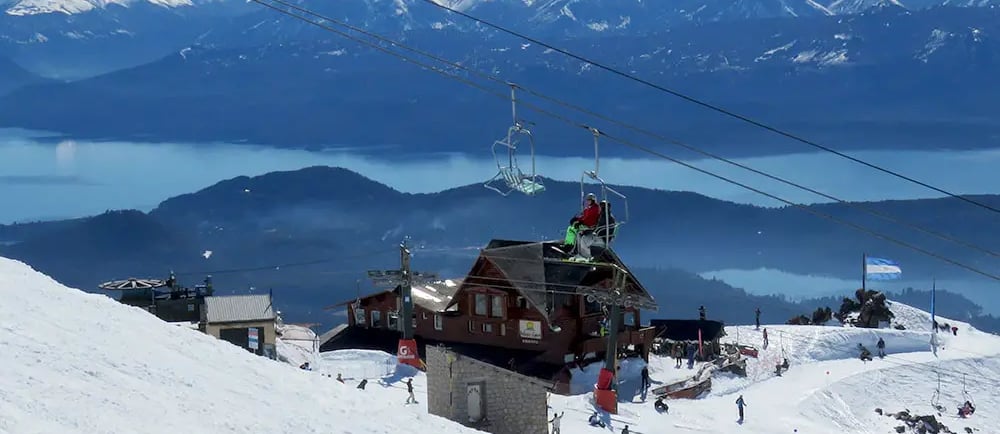
If there is one experience that separates a "nice" trip from an epic journey in Bariloche, it is completing the uninterrupted descent from the mountain's ridge down to the asphalt of the base. It is a vertical drop of over 1,100 meters (3,600 feet) where the landscape, the snow, and your own technique are put to the ultimate test.
For the 2026 winter season, Catedral has polished its "Master Plan." If you haven't visited in a while, you will find a redesigned mountain. Forget the old maps; today, the key is connection speed and knowing how to read the hidden tunnels. Let’s walk through the longest and most fluid route together.
The Ascent: The "Fast Track" to the Clouds
To ensure your legs are fresh for the descent, the uphill strategy is fundamental. In 2026, the winning combination remains the Ciprés-Ñire-Lenga axis.
Starting from the base (1,030 m / 3,380 ft), we take the Ciprés chairlift to gain height quickly. A pro tip few take advantage of: between the exit of one lift and the start of the next, the technical snow (produced by cannons at night) is your best ally to avoid scratching your boards if the winter has been dry.
When you reach the Lenga chairlift, pay close attention. There is a logistical secret: the Central Tunnel. It’s a covered metallic structure that allows skiers to pass beneath the lift line. It’s the "shortcut" that deposits you directly into the funnel for the Nubes chairlift—the highest point of our journey.
At the Roof of the World: The Nubes Panorama
Stepping off the Nubes chairlift is like entering another dimension. You are at over 2,100 meters (6,900 ft), and the air feels different. Before dropping in, make the classic U-turn to the left and take a moment to look at Lake Nahuel Huapi from above. That silence is what makes every dollar invested in your pass worth it.
We begin with the Nubes Panorama. Although the map marks it red to warn the distracted, it is actually a luxury cruiser. It is a "ridge" run, meaning you travel along the crest of the mountain. It is wide with a predictable pitch, ideal for releasing your edges and enjoying the view without pressure.
High-Altitude Traverse: From Punta Nevada to Refugio Lynch
The big trick to making this descent feel eternal is not losing the ridge. When you reach the Punta Nevada area, you’ll see the terrain seems to drop off. Many make the mistake of heading straight down, but for the full experience, you must "flank" the mountain.
Keep your line high, aiming toward the historic Refugio Lynch. It’s like a balancing act: you cross the slopes without losing altitude to link up with the Lynch Panorama. Here, Catedral shows its best face: a natural balcony overlooking the Andes Mountains that will leave you speechless.
The "Cañadón": Where Technique Gets Serious
As we lose altitude, the mountain becomes more "muscular." We enter El Cañadón, a true Red Run. Here, the pitch is real, and the snow is often more treacherous; it can be ice-hard or have "chunks" of snow sloughing off the side walls.
If you feel your helmet camera isn't capturing the steepness, don't worry—your knees will confirm it. This is the moment for disciplined skiing, maintaining control of your turn radius as traffic here tends to be more intense.
The "Cascada" Filter: The Final Stretch
The final segment takes us into Cascada, the run that revolutionized the lower third of the mountain a few seasons ago. It is modern and wide, but it has a "trap": it is the final funnel.
By the afternoon, Cascada becomes a survival challenge. The famous bumps (mounds of snow) form, and you’ll encounter skiers of all levels coming down exhausted. If you see many people sitting on the sides, they are waiting for a "gap" in traffic for the final sprint. My advice: if the snow is too broken up, take a breather before entering or descend with manual-perfect patience.
We cross the Events zone, carve the final turns on the flat, and suddenly, the sound of the wind in your helmet is replaced by the murmur of the crowd at the base. Challenge accepted and conquered.